Ford Granada Mark II

Cast your mind back to childhood summer holidays, and some of us are old enough to remember bucket-and-spade days on the coast of our own country, slurping up ice creams and trying not to get pecked by seagulls. The seaside town I grew up in was one of those places; long sandy beaches, deckchairs in the sun, and the hourly mad dash to the pubs and cafes because it started raining again.

In the Sixties, all that changed. Cheap package holidays sent the working classes off to the Mediterranean, where they could get wrecked on sangria, insult the locals, then come back with a straw donkey and some serious sunburn.

Ford of Europe knew exactly where all this was going, and knew that to market their lastest line-up of cars, they needed to tap in to this new-found Mediterranean flamboyancy. In line with the jet set, the names Cortina and Capri had been chosen to adorn Ford's saloon and sports cars respectively, instilling the range with a fun-in-the-sun flavour and conjuring in the minds of potential buyers the image of drinks by the pool filled with fruit and umbrellas. To continue the theme, the Large Executive Saloon had the name of a Spanish town slapped on its rear end, and was flogged to the masses as the Ford Granada.

The car itself was standard fare, with the straight lines and large cabin space a known formula, proven to have worked on both the Cortina and the Escort, which is no surprise considering the brainpower that had gone into them. The two European Ford corporations of Britain and Germany had collaborated on those projects to make continental cars that could be built and sold in both countries, and the Granada was to follow the same successful recipe. With a steady reliable drivetrain nestled under a roomy yet sensible body, the car won over managers and chiefs on both sides of the Channel, becoming a staple of the highways and putting up a decent fight against other, more luxurious contemporaries.

And as the Seventies exploded, so did the story of Granada, both the town and the car. The former, throttled for years by the oppressiveness of its dictator-general Franco, suddenly boomed as airports opened and hotels sprang up all along the coast. The beaches accepted a trickle, then a stream, and now a torrent of fat Northern Europeans, slathered in suntan lotion and basking their bellies in the sun. And in 1977, the Granada too went through a revolution, and with a new range of fleet-friendly engines and performance upgrades, it became an industry benchmark for affordable performance saloons, with Ford's beast comparing favourably to much more expensive offerings from superior manufacturers like Mercedes. The big men with cigars in both Dagenham and Cologne could slap themselves on the back for their cleverly designed Mark II.

Yet the cleverness of Ford's naming convention somehow became oddly reversed. Despite the engine range running from basic 1.6's to roaring 3-litre V6's, the car picked up a reputation not of poverty, but of the working class. Rather than the car absorbing all the foreign charm of its namesake town, the opposite happened, and the name Granada became permanently associated with fat sweaty Brits, sunburnt and shouting at Spaniards. The affluent masses, with their complete lack of social grace, tarnished the Granada forever.

It's that sort of social cheapness that sullies this Granada here. The single exhaust pipe and prosthetic-limb colouring point to the feeble engine under the bonnet, which is far more likely to be a four-pot from Dagenham than a V6 from Cologne. And yet someone has chosen to adorn both ends not just with "Ford" or "Granada" but with another name, "Berta", stamped boldly in black and white on the numberplate.

This sort of vanity is relatively common further west, where overpaid and egotistic executives purchase personalised plates for their cars, either as a display of wealth or, more cynically, for other more personal shortcomings. So for someone to pay such a price (and it's not cheap in Poland) to do the same thing to a decaying 30-year-old saloon is a particularly delicious joke. Are they desperately trying to catch up with the money that pours into Warsaw year after year, or is it a cruel jibe at the besuited owners of Porsche Cayennes, highlighting others' vanities by playing them at their own game?

Whatever the reason, Granada proved not to be the right name for the car, and for the third edition, released in 1985, the Spanish name was dropped in favour of the more astrological Scorpio; a sign that Ford no longer wanted their cars tainted by the actions of Brits on holiday. But I can't help feeling that, for a big heavy German such as this, Berta, or even Helga, might have been a better name.

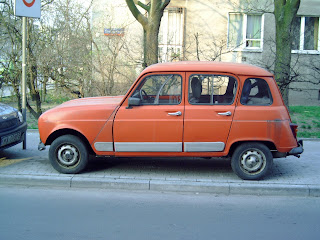
Renault 4 GTL

"Another glass, Jean-Jacques?"
"Merci, mais non, I 'ave to get zees onions to ze market for tomorrow morning."
"Oh come now, you 'aff plenty of time," says his friend, reaching across the table and filling the glass. In this way, two farmers let the afternoon pass, reclining on their seats and patting their prodigious bellies.

It all seems charmingly provincial, the old bistro in its rustic setting, a cobbled patio next to a sandy courtyard where old men in waistcoats exchange bon mots with a saucy waitress while holding aloft ruby glasses. It's exactly the image Renault want you to conjure up when you think of the Renault 4, but don't be fooled. France isn't like that.

While you carry in your mind two portly old rogues eyeing up the girls over a glass of wine, don't forget those all-important onions, without which the French economy would collapse, bundled up in hessian bags in the back of the farmer's Renault. That afternoon sun, which dapples gently on the paintwork, is roasting the glass-panelled hatchback, trapping the heat like a greenhouse and drying out the onions and their muddy coating until a pungent stench fills the entire cabin. It would mingle with the cigarette ash spilled on the floor, with the sweat soaked into the driver's seat, with the chicken droppings and vegetable litter compressed into the grooves of the bodywork until the car reeked like a pig sty in August. The underlying notes of poverty are the essence of the Renault 4. It stinks.

The Renault 4 would like you to think that it's a cheeky little people's car, an avant-garde flash of simplicity and quirkiness that lends it an air of jaunty enthusiasm. But it isn't. That sort of flair had already been done by the Renault's rival, the Citroen 2CV for thirteen years already, and post-war parsimony was now giving way to urban chic and a taste for the fanciful. That didn't prevent the French automaker from going ahead with their effort to take over a large section of the poverty car market; a niche that most other manufacturers had given up making new designs for. But Renault had decided more moustachio'd serfs needed to trade in their mules for motors, and so the Renault 4 was launched on a summer's afternoon in 1961.

On one hand, it's easy to highlight why the Renault 4 was a success. A simple engine mounted to a plain chassis allowed a relatively spacious body to be bolted on top, and with all the mechanicals up front and the suspension hidden underneath, meant that the maximum amount of space could be given to the body. Slap a simple barn door on the back instead of any pretence of a boot, and you've made a moveable metal box that can accommodate a cow. Pepper the sides with ovals of glass and you can even kid yourself that this is a car, and not just any car but a city car, a youthful car, a vehicle that embodies the urban spirit of freedom to move around. Of course, if you're also the person who has six crates of live chickens to move around, you might also find it useful, but the Renault 4 was designed as an Everyman's Car.

However, if you felt that the luxuries of a rear quarterlight window and a chrome grille were too much of an extravagance, and you didn't want to get your hubcaps dirty driving down farm tracks, you could lower the price even more and buy a Renault 3, the poverty-spec version of the '4, but in the Sixties even French farmers turned their nose up at such austerity measures. The Renault 4 was cheap enough already, there was no need to drag its new name through the mud by making it look like some sort of van.

Renault were very keen to point out that it wasn't a van by releasing a van version a year later, called the Fourgonette or "little girly van" if we translate the French appropriately. By unbolting the unpretentious body and slapping a massive box on the back instead, you could squeeze in even more agricultural produce, and waft an even more potent stench along the tree-lined roads before eventually arriving at whatever slaughterhouse you were destined for. Unlike the '3, the Fourgonette was an instant success, and helped push the image of the Renault 4 as a capable mover of stuff for the working classes. And with nothing in the way of extras to go wrong, it could almost be considered reliable too, as long as you serviced the engine every six thousand miles and didn't expect to go faster than 65mph.

With this elemental recipe for a mechanical donkey, the Renault 4 slogged on year after year with almost nothing in the way of changes, just like its competitor from Citroen. In some grim battle to keep the average quality of French cars to a minimum, they steadfastly refused to improve anything on their designs, lest they raise the cost of the vehicles to an unacceptable level.

But times change. The stereotypical French village became increasingly under threat as farmers realised they might have to start working for a living. Electricity came to town, standards were raised, and the demand for smoky tin boxes dropped. The cost of manufacturing, both in labour rates and the value of steel, meant that the price of the Renault 4 couldn't stay rock-bottom for ever, and by the time of the 1978 revision its price was comparable to those of contemporary superminis like the Citroen Visa and Renault 5. If one wanted a second family car, or a little car to learn on, the spartan interior of the 4 simply couldn't compare to the plastic and vinyl on offer elsewhere. Even the creation of a GTL edition with a 1.1litre engine couldn't bring it up to Eighties expectations of speed, let alone comfort, while the engine noise was absolutely deafening. What's more, the chrome grille had been removed. How can you sell a car in the Eighties with no chrome grille?

Yet the Gallic inertia towards change, or simply Renault hating the average consumer, meant that the Renault 4 managed to stay in production for an astounding 33 years before finally calling it a day in 1994, but before you breathe in a lungful on non-oniony air, bear in mind that the tooling for more Renault 4's had been dispersed around the globe. For three decades factories in Ireland, Autralia, Mexico and Italy churned out the plain little wagons until eight million of them cluttered up the streets with their nasal whine and cocky posture.

In its time it spawned a number of successors in both the Renault 5 and Renault 6, and made the hatchback style the ultimate small car design. Yet the final models were cobbled together from leftover spares in a factory in Slovenia; a relatively ignoble end for such a popular car. Upon its passing, its position in the French stable was filled by the completely unrelated Renault Twingo, but its place is automotive history is secured as Renault's most produced model ever.

Volvo 480 Turbo

The image of Volvo has always been one of a genteel conservatism. There's no outright snobbery involved in the brand, but those loyal to the Swedish manufacturer do seem to conform to a stereotype that may or may not be flattering. There's no posturing involved like other premium-priced models, no aggressive marketing designed to target a particular consumer. The Scandinavian manufacturer simply let its innocuous boxes appeal to innocuous people, as long as they had money to pay for it.

That's not to suggest that Volvo's are luxury cars; you don't expect leather and wood trimming when you sit in one, but it's definitely not at the lower range of the market, rubbing shoulders with disposable tin like Fords and Opels. They were sedate, safe saloons for accountants, offering a cosy way to move boxes of files and the family Retriever around without any particular sense of urgency. Cardigans were an optional extra from the factory.

Don't be fooled, however, into thinking Volvo's are slow; they're perfectly capable of keeping up with Audi's and BMW's (well, the smaller ones anyway), it's just that the owners have no desire to do so. While the German saloons excel in bullying other road users onto the hard shoulder, Volvo likes to plod along, knowing how much power it has and utterly refusing to use it, because it just wouldn't be sensible. As the Mercedes roars past honking his horn and shaking its fist, the Volvo owner will make a light tutting sound, and shake his head. In motoring terms, they are the embodiment of the word "comfy."

So when you hear that Volvo had produced a sort of, well, err, something along the line of a sports car, then the silence is only broken by the sound of teaspoons clattering onto saucers. "A sporting car?" enquires the husband, lowering his newspaper. "From Volvo? My word, really, this is really quite intolerable. I shall write a letter of complaint at once."

Volvo knew their target market, and what it would and would not accept. Which is why, on an average day in a nondescript ceremony they announced that they had built a Shooting Brake. A what? Hold on.

A long time ago, sporting gentlemen sat themselves on a simple, open wagon with long benches down each side, and let themselves be pulled around the forests and fields until they were in the appropriate place for shooting. With shotguns resting on their laps, knees warm under tartan blankets and flasks of brandy and whisky being passed around, it was all very much the quintessential country scene, and these open wagons, or brakes as they were called, were the lowest sort of rough-and-ready vehicles the moneyed classes were prepared to ride on.

Even if you're off out for some country fun, the prospect of spending hours staring at the back end of a horse loses its appeal. And despite the Eighties yuppy penchant for buying their way into genteel society, the average consumer shied away from actual mud and turf, so a real wooden-sided wagon wasn't exactly what was wanted. Some sort of combination, like a sporting estate car was in order, and if you're looking for an estate car, you look to Volvo.

This wasn't Volvo's first foray into the concept of a sports car; twenty years earlier Volvo had sold the 1800, rightly considered a classic these days. The trouble was timing; they released that car at exactly the same motor show as the Jaguar E-type, and given the choice, very few people went for the Swedish option. Price didn't help either; the 1800 cost more than the Jag in the UK, thanks to export costs, even though Swedish cars at that time were right-hand drive. In a bid to make the car seem more impressive, Volvo played around with the 1800, making a very small run of 8000 Shooting Brakes, called the 1800ES, before shutting down production in 1974.

That 1800ES was very much in the mind of one young designer when the call came from headquarters in 1978 that maybe they should have another go at making something sportier. Codenamed Project E12, Volvo Headquarters in Sweden decided to give their Dutch counterparts a test, and commissioned the team in the ex-DAF factory (which Volvo had bought a few years earlier) to come up with something radically new. The Dutch knew that they had to impress their Swedish overlords, or the whole factory would face closure, despite their ability to churn out the dull little Volvo 340. A sword of Damocles was hanging over them; develop a replacement for the Volvo's small car platform, or face the axe.

With that threat, and the radical brief of making a front-wheel-drive car, the Dutch team set to work, sketching out bold lines, rakish angles, acres of glass and pop-up headlights; all the marks of a serious Eighties roadster with none of the traditional elements that make up a Volvo at all. And a young designer by the name of John de Vries, returned to the old 1800ES as a source of inspiration. The short wheelbase was visually extended with large side panels and stretched windows, with the rear chopped off with a masterstroke of flat glass that opened up as a frameless tailgate. It was an daring design for the conservative manufacturer, but it won high praise from the Swedish top brass, and was put forward into production.

Unlike the cumbersome and wallowing Volvo 200 series, which was the standard brick being churned out by the company, the little 480 was to have a much more rev-happy and sprightly engine, courtesy of Renault. The little 1.7 litre unit was squeezed under the rakishly sloping bonnet alongside a turbo unit, with the whole setup tuned by Porsche engineers for optimum power. Since the back end of the car would now be "dead" because the power was at the front, the rear suspension would be handled by the English mechanics at Lotus. This thoroughly European effort was done to entice the Americans into spending their hard-earned dollars on the finished product, and to that end it was held together with an intricate web of cabling that controlled all sorts of technological gadgetry.

Considering this was Volvo, the electronic toys fitted to the 480 were things to make your life more practical. Alongside the airbags and ABS were useful gizmos like speed-variable wipers that automatically turned on at the rear if you engaged reverse, and door-timed headlights that stayed on for 20 seconds after you got out, to help you put your key in the front door. How thoughtful.

The trouble was, it was all very new territory for the Swedish manufacturer, and from the initial 1986 launch, tweaks and revisions were continuously made to get the car working properly, but the maze of electronics proved frustratingly stubborn. While the car never actually broke down, any number of on-board systems could go on the blink at whim, and even at idle the little 1.7 engine sounded cholic. Topped off with a disappointing exchange rate meant that the sporting Volvo would never get to see the other side of the Atlantic, and without American sales the model was effectively doomed. Even the introduction of a 2.0 engine in 1993 couldn't raise much interest, and two years later the model was cancelled, with only 80,000 units made.

Despite its sloping profile and short wheelbase, it never became a driver's car like it's brand rival, the Volvo 340, which should go some way to explaining why one would be sitting forlornly on steel wheels with rotting wheel arches in a Warsaw back street. Without the performance to match the low nose and sleek lines, this most un-Volvoish of Volvos could never be considered a serious sports car. It was just too serious.

Zaporozhets ZAZ-968

There was a time when the borders of Poland stretched from the Baltic coast as far as the Dnieper river, following its sinuous curves all the way to the Crimean peninsula. In those Golden Times the country, or the Polish-Lithuanian Commonwealth as it was known, was one of the largest countries in Europe, and a mighty force to be reckoned with. It embraced a multi-cultural society of Poles, Lithuanians and Ruthenians, defended itself from oppressive invaders, and enjoyed economic prosperity thanks to its exploitation of serfs and peasants. It fostered arts and sciences, maintained a diplomatic neutrality and led to the first constitution in Europe. All in all, it was a generally wonderful place to be. But there was one problem on it's eastern border, one trouble that couldn't be quelled. Cossacks.

Cossacks are a noble warrior tribe, a militarised group of Slavs who don't recognise any authority than their own. Fearsome on horseback and worthy seamen, they proved to be willing mercenaries for any number of East European nations through the ages, and piratical raiders when unemployed. Politically, they fell under the control of the Commonwealth, but little could be done to reign in their terror, especially their attacks on the Ottoman Empire. They would plunder and ravage at whim, always to return to their fortress settlement of Zaporizhia, by the rapids of the river Dnieper.

Officially, they were registered and employed as a battalion of elite soldiers, but by the middle of the 17th century those Cossacks became a menace, and through a series of revolts and incursions they destabilised the entire Commonwealth and sparked off the Deluge, a string of political and military events that would wipe Poland off the map. For the Cossacks, this was their attempt to be recognised not just as an underclass or military unit, but as a separate nation state, which they called the Zaporizhian Sich.

Since those times, Zaporizhia has calmed down somewhat, using its coastal waters to unload shipping cargo rather than captured booty, but the area still maintains a reputation for bucking the trend, for doing things their own way, and that can clearly be seen in the ZAZ-968.

Fast forward two hundred years, and the Communists have taken over the region. Desperate to get the Cossacks off their horses and into cars, they converted an agricultural factory into a production facility and set to work on their new project, the Zaporozhets. Reminiscent of the Fiat 600, the ZAZ-965 was a hunchbacked little lump with many similar features to its Italian doppelganger, most notably the rear-mounted engine. It wasn't exactly a technical revolution, which is no surprise since it came from the far more mundane Moskvitch design office. But the Cossack engineers had more ambitious plans, and from their design centre in Melitopol they created a unique engine for the pint-sized car. The MeMZ V4 750cc engine was unlike anything else in the Soviet automotive arsenal, and its compact structure perfectly suited the tiny engine bay at the back of the ZAZ. It wasn't powerful, but it was air-cooled, and that made significant savings on complexity as well as weight, and allowed the miniscule ZAZ to roll off into the Great Meadows with a herd of 27hp.

The little ZAZ showed that the principle of a Ukranian People's Car was certainly achievable, and the factory worked hard to expand its options. In 1966 it unveiled a bigger saloon platform, the ZAZ-966, which bore an uncanny resemblance to another air-cooled Sixties saloon, the German NSU Prinz. But the Ukrainians couldn't leave it like that. The Cossack attack is fast and light, quick strikes, and even though the 966 wasn't a big car, it's engine needed a lot more power than 750cc could deliver. So MeMZ enlarged it, making it first 900cc and then 1.2litres, gave it an ever-so-slightly different nose, and called it a ZAZ-968.

Released in 1971, this was the car that everyone knew simply as the Zaporozhets, and many alive now still remember the glorious times when their grandfathers owned one of these distinctive machines. Those rear vents quickly earned the car the nick-name "Uszy", or Ears, and they were responsible for sucking the air into that rear-mounted engine, and it's those little quirks that have earned the car such a loved-and-laughed-at reputation.

Because the car was designed to be the ultimate People's Car, simplicity was the byword of design, making the car as ergonomic as possible to fit into the peasant lifestyle of the Ukrainians, and the Soviet Union as a whole. Internal heating was provided by a separate petrol burner with its own tank, so that the engine didn't need to be run to keep the cabin warm. The wheel rims mounted directly to the brake drum, with bolts around the edge, to save on weight and metal. And by making the car was so light, the little engine needed to be revved hard, so the gearbox gate was redesigned with first gear standing out on its own, down and to the right. That way, it would be much easier to shift between second and third gear when negotiating the potted Soviet roads. Handling could be improved by filling the front cargo bay with rocks.

The car was a peasant uprising of a machine. There were never enough cars to satisfy the needs of the Soviet Union, but the ZAZ became the icon of underclass motoring, with its simple design making it perfect for invalid carriage conversions. Its basic setup could be adjusted for those who had lost a limb or two in battle, with both the accelerator and brake hand-operable. And with such a reduced design, it carried the ultimate weapon; price.

The Zaporozhets was such a cheap car that, when exported, it still cost less than the Skoda 105 or the Fiat 126, and workers up and down the country were desperate to get their hands on one. This would never be a status symbol like the big GAZ Volga sedans, but it quickly became a cultural icon, and even contemporary owners of the cars, thirty years afterwards, claim their ownership with pride rather than embarrassment. The general public have more ambivalent feelings towards the car, but most people have at least one story to regale of the time they encountered the strange machine from Zaporizhia. However, like the Cossacks, it's great to talk about the ZAZ, but the idea of having to rely on it instils us with fear. Like their ancestors, the Zaporozhets had a reputation for unreliability, and you never knew when it would turn around and leave you stranded and unsupported, or worse.

For that reason, the ZAZ has left behind a cultural legacy of both scorn and admiration. All of the criticisms, such as a lack of power or poor build quality, are exactly the things that endear the car to its owner, in much the same way as other People's Cars like the Trabant or the Syrena. And just like those two, the more Zaphorozhets tried to improve the car, the less likeable it became. In 1980, power was increased by the clever men at MeMZ, who managed to squeeze 50hp out of the already gasping engine, but at the cost of those distinctive ears that give the ZAZ-968 its charm, and the 968M was a poor replacement.

The looting days of the Zaporizhian invader have long since ended. Just as Zaphorizhia was flooded by the Kakhovka Dam, inundating the Great Meadow with a deluge of its own, so too did air-cooled engines fall out of favour against the unstoppable tide of water-cooled engines. By 1994, the ZAZ-968M was a dusty relic of the late Sixties, and no amount of gimmicks and cheapness could prolong its execution. As it bowed out, its shoes were filled by the smaller, and also-but-slightly-less outdated ZAZ Tavria. And with its demise, a worthy enemy, or charismatic ally, passed into legend.