Wartburg 353 Estate

It's very hard to comment on a utilitarian object. I imagine it would be similar to reading a blog about light bulbs, comparing and contrasting the light output, ease of installation, likelihood of burnt fingers upon removal. In fact, there's probably already a blog out there covering this stuff, if you're interested.

The Wartburg 353 fits in that category. It's so practical, so unpretentious, so frank in its statement that I can't help but like it. The statement being, of course, "I move stuff around."

If you want to get from A to B, the simplest and cheapest way is via Wartburg. It's a three-box car with the corners filed off to stop anyone getting hurt, with a pingy little two-stroke engine up front. Suspension is simple and the lights look like they were glued on as an afterthought.

If this car had been built in the West, it would probably have been marketed as "bold" and "assertive" and all the other rubbish reviewers use when they try to make something sound exciting and edgy. The Wartburg isn't any of that. It put out a crippled 50bhp that could propel it over 100km an hour if you had a free weekend. And if it was wet, you'd better hope A-B was a perfectly straight line, as in the rain the wheels might as well have been made of sugar.

The simplicity of the design betrays the lengthy origins behind the Wartburg brand and the 353W in particular. Spawned in 1966, the 353 was built by BMW. No, sorry, this is an EAST German car, so that's EMW. Either way, the base model is actually of Polish origin, being most of the mechanicals and the shell from the never-produced FSO Warszawa 210, of which the only definite produced example resides in a factory about 1500m from where I found this Wartburg.

Unsurprisingly then, comrades of consumption in the old DDR were, well, not exactly anxious but definitely eager to get their hands on the car. With the factory struggling to pump out 100 cars a day, some customers had their names on the delivery list for 10 years before receiving their blunt-nosed little oil burner. Had Poland not agreed a deal to produce the Fiat 124 instead (oops, I mean the Polski Fiat 125p) then the Warszawa 210 would have been stolidly rattling around the roads too, although probably with the same 2.4litre 4-cylinder engine tjat powering everything else in Poland at the time, rather than the Wart's little 3-cylinder two-stroke.

Instead, this decaying example in varying shades of matt paint and filler represents, if not the bones then at least the cartilage of the old German Democratic Republic. The Wartburg went through the wringer with Volkswagen who failed to make it profitable in the new Capitalist market, and Wartburg, like 8500 other DDR state companies, was sold off to Opel and the factory flattened.

In much the same way, it is completely uneconomical to own a Wartburg these days, and the solid matter of their existence and purpose weighed up against so many Deutchmarks (or zlotys, or even the Mickey Mouse Money that is the Euro) is a sad sight to see.

Volkswagen Scirocco

There's a pigtail bridge in Warsaw that takes you from the sedately cobbled and palace-lined Royal Route down to the riverside, and it's called Diamond Street. It was and still is used as a rally stage by classic motoring veterans who race up its coil, pivot round on a handbrake turn and then roar back down to the awaiting thunder of applause and cheers. Riding your bike down it, then, is a simple pleasure of wind-in-your-hair speed, bouncy buttock-clenching corners and a revelation in anatomical intimacy between yourself and your chosen ride.

It's a street that demands the driver's attention, so when I saw a perky 80's wedge parked up at the second bend, I was so distracted by it that I braked too hard, skidded, hit the kerb and discovered an even more emotional intimacy between my body and the pavement. While my vision reasserted itself, I wondered how a VW Golf had got so squashed and stretched, until I realised it was a Mk I Scirocco.

You can't really imagine a more perfect place for a car like this. Designed specifically to sports-test the embryonic Golf technologies of 1974, it was a thoroughly German take on the idea of a coupe. Multi-faceted and clean-cut, like the best of diamonds its purity comes with its simplicity. With no need for gauche tasteless extras like air-con or power steering (and with no legroom for rear passengers or boot underneath the hatch), the Scirocco was solely for throwing around twisty city streets, skinny tyres squealing and driver bouncing with fear and glee. The story of how the Golf took all of that, made it more boring, and then went on to revolutionise the motor industry is a story so well documented I won't dull you with it here, but its one that regularly omits the section about its older (by three months) and sexier sister.

What the Golf had in spoonfulls, the Scirocco had by the shovel-load. Hand-forged at Karmen rather than churned out by Volkswagen themselves, the Giugiaro folded-envelope sketch was wind-tunnel perfected into the little city slicker with German precision. Over its lifetime it had Audi engines chucked into it, GTI badges before the Golf did, vented disc brakes; it remained the rolling test platform for almost everything the Golf was to have with such worldly proclaim, but pulled it off with just that little more polish.

So while its yappy little upstart sibling became a religion, the wide and menacing Scirocco was doomed instead to cult status. Squint carefully at the 1978 cult classic film "Dawn of the Dead" and you'll see the four survivors of the zombie nightmare racing round a shopping centre in a silver Scirocco. And that is about as iconic as it ever became, until the idea was overhauled in 1981 and the Mk II was born.

Despite the Mk II being the more recognisable and reknowned, both for its blockier stylings and power characteristics, there were nearly twice as many Mk I's produced, with over half a million growling out of Osnabruck in 7 years. That's 200 a day, and yet now there's estimated to be less than 2000 in the world, according to German vehicle licensing statistics. So where did they go?

If you go by word of mouth, horrendous rust problems (those front wings had no plastic linings like the Golf did) and dismal brakes were major contributers, even though the brakes received far better reviews than contemporary sports coupes like Porsche. The one in Dawn of the Dead had an intimate moment with a concrete pillar inside the shopping mall, while most of the rest were so heavily modified by eager yet inept teenagers that they fell apart from shame. Finally, there was simply no way it could compete with the Golf, whose GTI version was essentially everything a Scirocco had and more. Trapped between the little sister and the bad boy cousin in the form of the Audi 80 Coupe (from the VAG group too), there was nowhere for the Scirocco to go in its current form but six feet under.

Like the zombies that gave the Mk I Scirocco its brief moment of recognition, VW has announced that the platform will be returning from the dead in exactly the same idea. They're poised to release a stretched Golf with Golf engines and Golf running gear, but unlike the Mk I it will be wrapped up in a shell from the current "post-abortion foetus" design school that typifies the VAG group. While the first Scirocco was so delightfully simple it "upgraded" from two windscreen wipers to one, the Mk III will undoubtedly have cup-holders, heated leather seats, sat nav and all the other gadgets that will make a tear down Diamond Street feel like a stroll through a shopping centre. If only contemporary designers had the one thing the new Scirocco craves - braaaiiiiinnsssssss.

Opel Ascona C 1.6

It's difficult not to notice the Opel Ascona, even from a distance, for a number of reasons.
Firstly, this one's bright green. Secondly, it doesn't bare the proud red griffin on the front like it should. And thirdly, its conspicuous in its abscence.

Addressing those things in order, it's not too often you see a multi-shaded scabby old motor in a severely dubious shade of grun with brown rust and grey filler splattered about the place. Especially not in Powisle, home of the Warsaw University Library. With its genteel air of riverside apartments, tree-lined avenues and views across to the Royal Palace, this is not the usual haunt of a ropey old Opel.

And Opel it is. For an Englishman like myself, this is confusing as it ought to be a Vauxhall Cavalier, with its distinctive heraldric badge. At the end of the day, both companies are GM, but I'd like to point out that GM bought Vauxhall first and therefore all Opels are Vauxhalls, and I don't care if they're built and designed in Germany, Japan or Australia - they're still all Vauxhalls.

For a car this badge-engineered, you'd think its continued presence on the roads of Europe would be guaranteed. After all, 1.7m units were churned out of factories in Russelheim, Luton and Antwerp, and sporting its lighting badge it was the biggest selling car in Western Germany. It also sold as the Holden Camira, the Isuzu Aska and the Chevrolet Monza, in various engine configurations, body styles and trim levels.

The example in the photos is a 1.6 S hatchback, spurting out 82bhp of fury from its single-carbed powerplant. It's one of the very early models, before they tried to prettify the line with different grills or clear plastic indicators. What that means is that, as it stands, it's at least 24 years old, with all the battlescars to prove it. The interior might be a hideously dated mess of brown vinyl and tweed uphostery, but mechanically it was perfectly suited 1980s motoring, with its front-wheel drive and transverse mounted engine.

This car was designed from the ground up to be GM's most stable platform; all versions of the J-platform on which the car is based were meant to compete in the fleet markets for regular heavy commuters. While the Kadett and Astra went toe to toe with Ford's Fiesta and Escort in the small car section, the Ascona put up a valiant effort not just against the Cortina/Taurus, but against that love-muscle supplement of the city suit, the Sierra. And performed admirably too, racking up the miles, and the sales, among middle management in countries all over the world.

Rather alarmingly for a car this popular then, is the fact that in Britain it is one of the most scrapped cars of the last 30 years. It is this that makes the Ascona so noticeable - that really, it should still be so profilic on the roads that you don't notice them. The ones that are still knocking around are mainly in the same condition as this one too; a roll of gaffer tape and a tube of instant gasket away from a safety certificate failure. About 10 minutes after I took the photos, I saw the same car struggling its way up the Warsaw escarpment to the city proper, fat old man behind the wheel, wisps of blue smoke curling behind. There was no love between the driver and the car, just a simple working relationship between man and beast.

The Opel Ascona is a failure of its own success. Sold in the thousands, it was never going to be recognised as a classic, or indeed as anything special. It was bought, used, abused and dumped. So take a good look at the revolting paintwork and garish indicators; production dried up 20 years ago, and rather than being put out to pasture, like the sheep dog of yore, too many of these have been taken to the end of the field and shot in the back of the head.

It's worth noting that the Daewoo Espero, assembled in Warsaw's FSO factory directly over the river from where I found this Ascona, is little more than a tarted-up version of the same car, built on GM's J-platform. It's still very much a common sight on the roads of Poland, and owes its continued existence to the furrows ploughed by its hard-working older sister.

Peugeot 304

I'm not a big fan of French automobiles. Now now, before you climb onto your high horse and cry "of course you don't, you're an Englishman," let me assure you that I've thought long and hard about this and have come to the conclusion that you're probably right.

I've owned a fair few frog motors, but not enough to claim to be an expert on them. I'm not going to point to their continuous track record of unreliability, and I'll even give a nod of admittance that French manufacturers produce some of the most innovative, extraordinary and downright revolutionary designs in the long history of car production. The simple fact is that despite all the hydropneumatics, one-spoke steering wheels and inboard disc brakes, I just find it rather difficult to feel passionate about these vehicles.

It is undoubtable that most of the head-turners on the roads for the past 50 years have been French, and I do even now harbour a guilty desire to buy a Renault Avantime, even though I have no clue what I'd do with a two-door MPV. I like looking at the Matra Rancho even though I know that it's a Matra, and last week I accidently slapped my girlfriend in the face whilst driving, overenthusiastically pointing out a Renault Fuego, the likes of which I haven't seen in yonks.
But when I lie in bed at night, I don't lust for a Gallic hatchback or curvy cabriolet. For all their va va voom, they leave me soulless.

What dragged my eye to this otherwise charmless Peugeot 304 was actually its paintjob. GOLD. Luxurious Midaslike gold. Not the lacklustre silver that so many contemporary saloons are slathered with, but a shiny, reflective, everything-I-touch gold. A colour so intrinsically linked to opulence and exclusivity that in the 1970s, almost every other car on the road seemed to be gold. Its ubiquity became the butt of jokes, so much so that when I bought a 1978 Vauxhall Viva and phoned up the insurance company to get a quote, the woman at the other end asked me what shade of gold it was. When I told her it was red she commented "ooh, the luxury edition," and giggled at me. Phwoar.

Gold, for all its monetary charm, lends more to our nostalgic view than any rose-tinted spectacles could. The distant sepia of time-stained photographs recall a sentimental twinge of gold to our fondest memories, when long summer holidays were bathed with slanting rays of liquid sunshine, when you held your first sturdily solid pound coin, when things seemed to glisten that much more than they do now. The gold alloys on a Subaru WRX just don't evoke the same emotion that huge panels of rust-succeptable steel sprayed in gold do. So when you finally see a little old hatchback tucked next to a massive chequer-plated 4x4, some little inner part of you will smile sentimentally.

But not specifically for the 304. For all its swage lines and chrome work, it was little more than a gap filler between the baby 204 and the giant award-winning 504. The drawing-board idea must have seemed perfect; a small family car with simple but solid mechanicals, designed to suit 1969 tastes. What that physically translated as was robbing all the old motors, disc brakes and suspension from the middle aged 204 and planting them in a cut down 504-styled body; a real mouton dressed as lamb, if you like, which couldn't really compete with the far more French Citroen GS, released a year later. Not that it was a bad car, per se, it just didn't really offer much to the world.

While your modern motor is available in CloudEdge Silver, Smoked Silver, Ditchwater Silver and I Can't Believe It's Not Silver, plus a myriad other hues and shades of that dull steely tone, gold takes true bravery and nochalance to carry off. The boxy bruisers of the 70s could justifiably swagger in it, but not the timid little 304. This car is a Fool's Gold, if you will. The Pyritical Peugeot.

UAZ-469 (31512)

The Communist Tonka. Known in the Russian-speaking world as "Kozel", meaning Goat, primarily because it'll go anywhere, but also because it's a stubborn bitch and "kozel" is not a particularly pleasant word in Russian. And the UAZ is very much a swear word of the vehicular world; insulting, uncouth, ill-mannered and certainly not for polite company.

You normally have to be on the receiving end of a Russian invasion to experience one of these vehicles, but seeing as I was strolling around the abandonned 19th century Bemowo Fort (one of a ring of defensive structures erected by the Tsarist overlords around Warsaw during that particular occupation) then I don't really deserve to be surprised by such a display of Russian might.

The UAZ-469 went EVERYWHERE, and still does. To use words like Jeep, Land Rover or SUV in its presence are to demean its very existence. This is not some prancing pretty-boy offroader with alloy wheels, Xenons and cup holders; this was the no-nonsense mule of the Warsaw Pact states, held back only by its need to drink up 24litres of fuel for every 100km it rattles along the road.

And rattle they do, along with roar, bellow, squeal and groan. And thats what they like, too. Unlike the current fad for shiny brightwork and spray-on mud, the UAZ is very much of the "treat em mean, keep 'em keen" school. Abused, mistreated, having their nuts revved off as they're thrown carelessly through fields of both farm and battle, the UAZ will lap it up and chortle for more. And even if you do bend, snap or ruin something, part of the design brief was that it should be repairable with a stout stick and a large hammer. With this sublime simplicity, it's even been known for Land Rover owners to try and pinch parts from UAZes to improve their own vehicles.

With this much power and capability at hand, it didn't take long for the public to clamour for their own model of the otherwise military-only UAZ, and year by year a few trickled their way into the hands of private owners. Eventually a UAZ-469B roared its throaty way out of the factory with reduced ground clearance and other differences, for the civilian market.

I only had a chance to poke my head around this dilapidated example for a few minutes as I didn't want to get bayonetted by a possessive security guard, but the one in the pic, despite being sat idle for a while, could no doubt be hurtling its way around the fortifications without too much work, a thought both thrilling and chilling in equal measures.

With its simple fearsome supremacy, the UAZ-469 is one of the last remaining diplomats of the Cold War mentality; the idea that brute force massively applied can crush opponents into submission. For that reason alone, its no wonder that this one has taken refuge in the weed-strewn car park of a military fort, as its active service in Poland was as one of the cars of choice of the loathed ZOMO, the equally brutal and suppressive Communist Riot Police force, whose atrocities have still so far gone unpunished. Painting it yellow still does not soften the fact that it has "Security Office" tattooed on its flanks, and I doubt that there is little love lost between this Soviet dominator and its host country.

For now then, this faded example of Ulyanovsky Automobilny Zavod's finest lies dormant in its fortress, awaiting its inevitable return to arduous, angry and enthusiastic service.

Skoda Rapid Coupe

Back in 1981, Skoda was a Communist producer pumping rear-engined saloons out of Czechoslovakia factories to the amusement to the western world. We've all heard the jokes, and the only relief was when we all pointed our fingers at a Lada instead. Indeed, Skoda Rapid was considered an oxymoron to those who wouldn't stoop to riding in one.

Of course, some of the comments levelled at Skoda might have been deserved; by the 1980's a lot of the technology involved in putting them together still dated back to the 1960's, and the whole idea of an engine in the rear driving the wheels was laughable. Who the hell could pull up at home, open the bonnet and take out the family shopping? Christ, most Englishmen (or rather, their housewives) would die of embarrasment.

In fact, the idea of a serious rear-engined, rear wheel drive vehicle was ridiculous. Sure, it's good enough for the charmingly laughable Fiat 126p, but the only truly driveable car available to the consumer in 1984 was the Porsche 911; a sports car within the financial grasp of just enough people to earn itself a reputation as a seriously enjoyable driving experience. Hanging onto its coat-tails then, those plucky few Skoda Rapids that made it off the forecourt were quickly dubbed the Poor Man's Porsche. Weighing in at 840kg, 58bhp was enough to get wheelspin, and the Block from the Bloc still has a firm following amongst purist and tuners alike, being as much a joy to throw around corners sideways as its sturdy Stuttgart sister. And remember, Porsche is just the dark horse of Volkswagen, the company who have succesfully stripped all the emotion out of Skoda in the last 18 years.

This particular Rapid I found whilst desperately trying to get away from Bemowo, and seeing it's plastic-bumpered posterior put a wry grin on my face. It's one of the later facelift models, which saw the powertrain overhauled and, more drastically, the dumping of traditional Commie frogeyes for the Estelle's chunky block headlights. Whether or not this is a 130, 135 or 136 is not really an issue, as the difference amounts to four horsepower, a pittance of torque and probably some plastic bits of trim 3mm wider somewhere, which some pedant will eventually point out to me unasked. Considering how many of each model were made though, and that Poland back then was a cheap as chips state, chances are this is the bog-standard 130.

If you squint at the pics, someone's deliberately removed the Skoda badge from the front, and they had been properly removed from the back too. You'd almost think that someone was embarrased to own a Skoda, and I'd much rather think it's so that the car could have a respray from a loving owner instead. But then, ho ho, of course it's had a repspray, it's 20-odd years old and was held together with chewing gum from the start. Oh, you wit. Tell me another.

And then, once you've wiped the spittle from the corners of your mouth and slapped your mate on the back for a joke well told, remember that the Rapid name has pedigree, winning the 1936 Monte Carlo back when Porsche could only make glorified Beetles. And even if they did rust, and couldn't normally hold their own against their technologically advanced western brethren, or weren't that endowned engine-wise, there's no need to go denying a motor like this of the admiring nod it deserves. A Skoda Rapid is a wonderful take on the Coupe form, and in burgundy red it demands recognition in exactly the way modern Skodas don't.

RAF Latvija 2203

Bemowo is one of Warsaw's most western suburbs. Constructed on the unused aprons of a military airport, its regimental stacks of Communist blocks reflect the concrete slabs the town was built on. Wide roads and a dedicated tram loop envelop clusters of aparments whose long shadows shelter primary schools, gyms and a charmingly modern church. Like the conscripts in the military academy at the town's lip, Bemowo's residents rise with the sun, march to the trams and file themselves off for a hard day's work.

With life this plain and organised, there's therefore not much point traipsing through the speed-humped tarmac lanes that coil themselves between the tower blocks, and for most of the week, lines of dull silver late-90s cars stand bored and unwanted in the carparks. It wasn't until last weekend when good weather and the subsequent exodus to the lakes and forests left Bemowo alarmingly empty. Which is how, stuck in the city, I stumbled across a crumbling dark blue van that looked like it had been assembled by a drunk Communist 30 years ago.

The RAF Latvija minibus is exactly that. Despite the appropriate military acronym, RAF actually stands for Rigas Autobusu Fabrika, a light truck assembly plant in, unsurprisingly, Latvia. Making vans for Soviet Union State purposes (ambulances and taxis mostly, or if your family had more than five kids), RAF used technologies from the Russian GAZ cars to build 2-tonne transport platforms for 50 years. By 1976, the factory could churn out 17,000 examples at its Jelgava plant, and that model was the GAZ M-24-based Latvija 2203.

When the Jelgava factory opened, however, the GAZ-24 that provided the technology of the van was already eight years old, and no amount of steadfast Communist hard work could turn the RAF Latvija 2203 into a master in light goods transportation. The cast iron 2.5l engine only kicked out 95bhp, and it's location under the front passenger seat didn't help in terms of exhaust fumes. Slow, heavy, and with the tendancy to poison its patients with carbon monoxide, the 2203 was useless as an ambulance (despite 30% of production models being them,) and with drum brakes all round to halt its massive 2.5t bulk, it would occasionally require another ambulance to attend to the carnage inflicted by the van's design.

In the Polish market, there was simply no way the foreign RAF could compete with the more agriculturally designed (and locally produced) Nysa and Zuk vans, which makes the sight of a Latvija in a military suburb raise an eyebrow as high as the 12-storey blocks that surround it. Of course, they were exported all over the Bloc during their 23-year production run, shuttling officials, mail, interrogation victims and corpses around such far flung places as Cuba, Bulgaria and Iraq, and can still be seen in the background of some war reports today, despite RAF's bankruptcy in 1998.

It was hard enough to identify this particular example anyway, what with the broken remnants of the cursive Latvia logo hanging off the nose and the grill badge faded beyond legibility. It was only the angular bullnose poking out with sad, watery headlights that drew my attention in the first place. Slavic winters have not yet rotted this thing through, but the fact that most of the engine is strewn over the back seats, and the view from the cab to the brick paviers below tell us this van won't be carrying any more patients (or victims, if you prefer) any time soon.

As a hulking angular Communist chunk, however, I couldn't think of a more fitting resting place.

Lancia Trevi Volumex VX

The car that inspired this whole online debacle.

Whilst out for a wander among Warsaw's crumbling industrial ruins, I saw through the chinks in a fence a pale blue wreck. Windshield gone, grill gaping wide and one front light smashed like a defeated boxer, I initially thought it was an old Volvo 200. It couldn't be a Peugeot 305 (although it deserved to be) and so I clambered through a gap in the fence to take a closer look.

The Lancia Trevi was not a car I had ever heard of, as I spat on my rear finger and wiped clean the badge on the boot. Spawned from the same line that created the far more appealing Lancia Beta, it was a rather uninspired (Trevi is derived from Tre Volumi - three box) early 80s saloon that, visually, failed to live up to its stablemates like the Beta Coupe and the HPE (High Performance Estate.)

But Blandwagon it ain't. What made this particular Trevi so special was the weedy cavern where the 2-litre Volumex supercharged engine should have been. When it rolled out of the sun-scorched Turin factory 25 years ago, this beast would have spurted out 136 horses-worth of power to the wheels. Dull on the outside, but fierce under the bonnet, less than 4000 Trevi VX's were assembled and sold, despite it's brisk 190km/h top speed. Considering it's unpopularity at the time, the fact that this shell has survived this far is worthy enough of comment, and the argument towards restoration falls in the name of rarity.

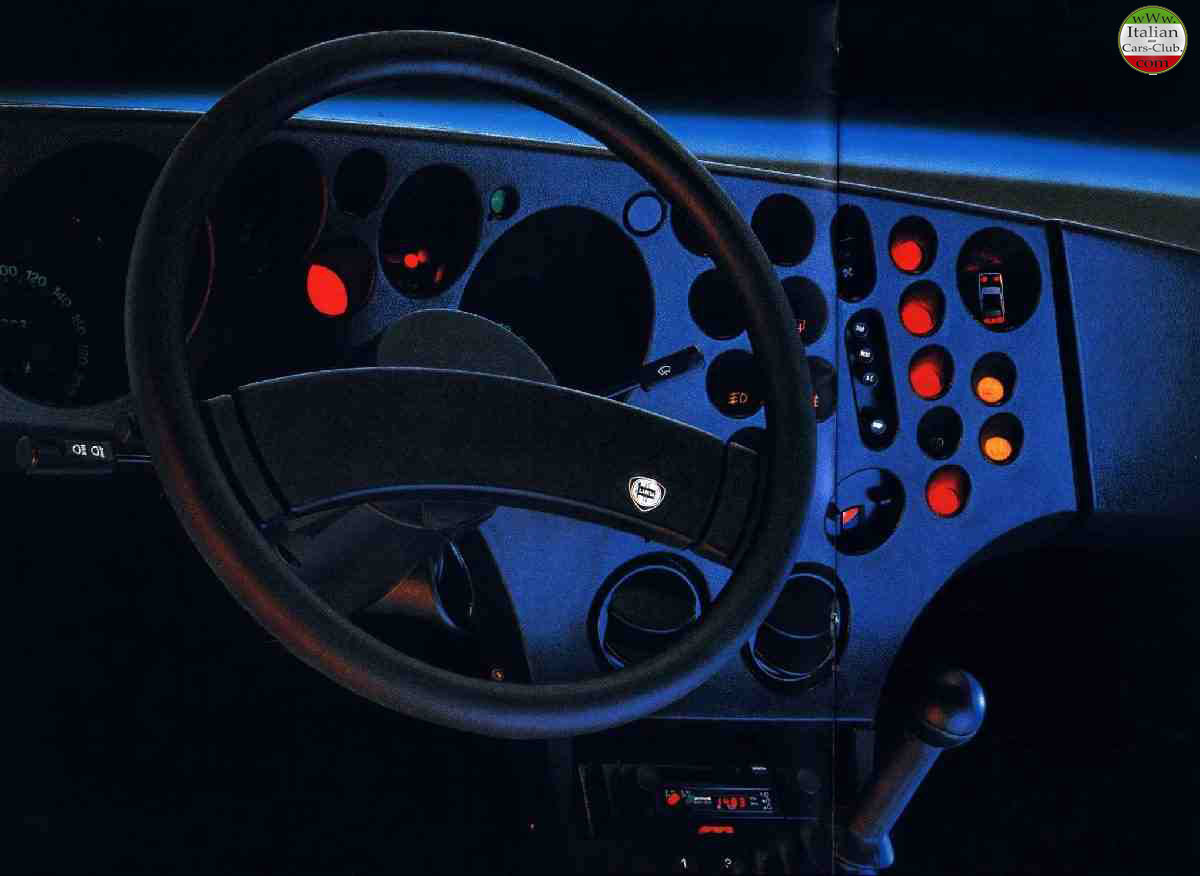
This example, however, has been robbed of the two iconic pieces of construction that made it such a significant piece of engineering. The yawning maw of the engine bay was one heartbreak - the grim disaster of cables that represented the long-absent dashboard, riddled with recessed buttons like bulletholes, was the other. Instead, this Trevi is little more than a blocky lump of Italian panels filled with perished window rubbers and furry seat coverings. How the hell it got to Poland in the first place is a mystery, but the thought that such a rare Italian car has been grave-robbed to upgrade the engine of a Polski Fiat is too painful to bare.

The only chance of salvation would be to sacrifice one of the Trevi's more desirable stablemates of the Beta clan, but time, money and parts availability are, as always, strong factors in the face of this Trevi's continued future. When this entire area of Warsaw is redeveloped (which is happening at an alarmingly furious pace) this Trevi will be dug up, squashed and forgotten like the weeds around it.